Tripod.com and the Growth Curve That Changed the Internet
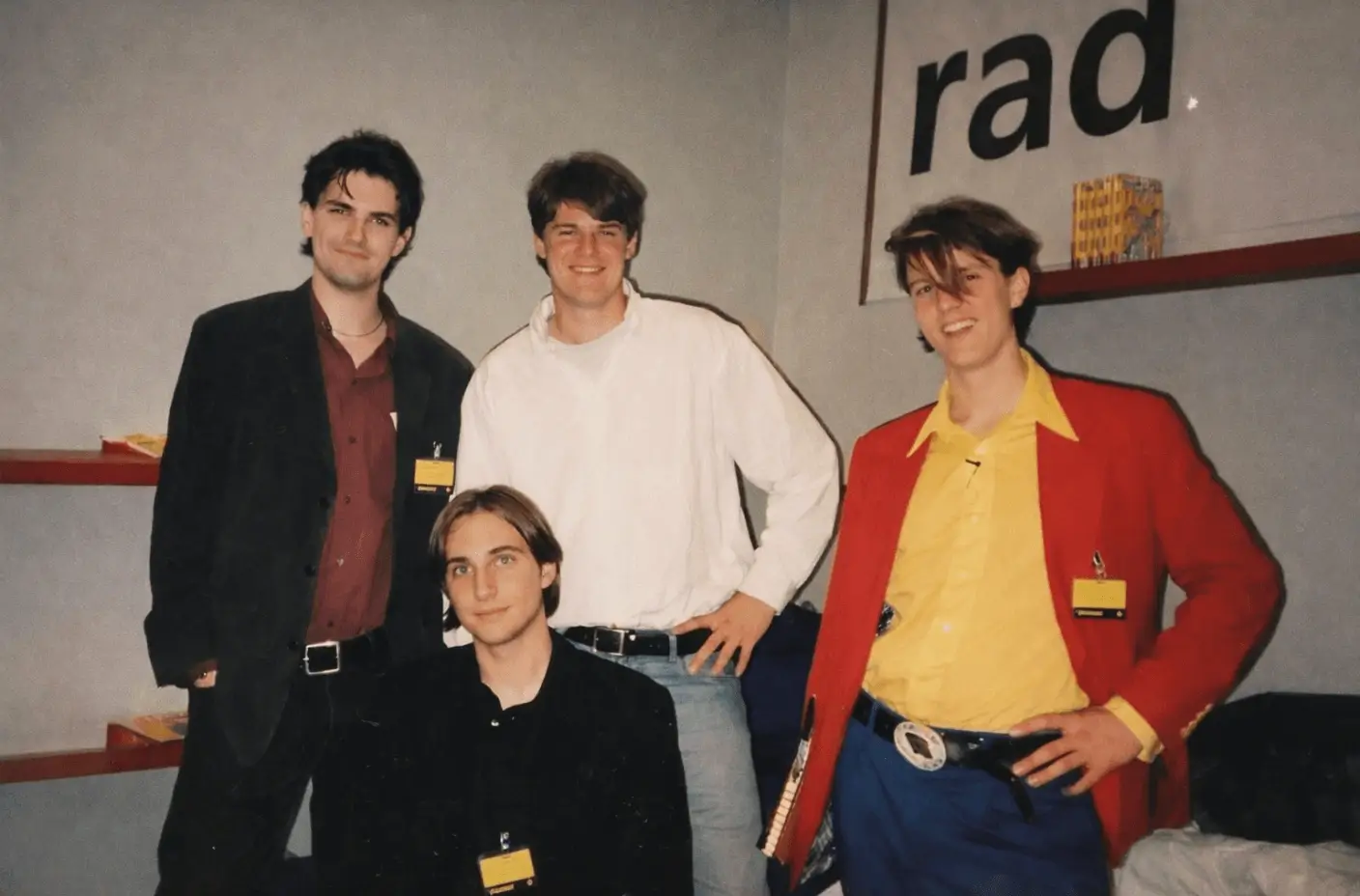
In the summer of 1995, inside a rented white Greek revival house a short walk from the Williams College campus in Williamstown, Massachusetts, a small team of twenty-somethings pushed a new feature live without much thought, fully expecting it to join a growing pile of clever (but largely ignored) experiments. The feature was (almost) embarrassingly simple, and it allowed anyone to create a personal homepage in under a minute, complete with a title, some text, maybe a photo, and a hit counter that ticked upward every time someone visited.
That counter turned out to be strangely magnetic. Watching the numbers climb made the page feel alive, like proof that someone out there had actually found their little corner of the internet.
Bo Peabody, the young founder running Tripod out of that house, barely gave it a glance, because he had already spent years chasing product ideas that felt smart but failed to catch fire.
The following morning, the office that had grown accustomed to modest traffic and modest expectations began to hum with a different kind of energy, as users started launching new homepages every 10 seconds, then every few seconds, and by the end of the day at a rate that felt indistinguishable from continuous motion, like watching a slot machine that would never stop hitting.
That was the moment Tripod stopped being a scrappy web skunkworks project and became a legitimate startup that people actually paid attention to.
Before the Web Belonged to Everyone
To understand why that homepage tool grew the way it did, you have to rewind to when Bo Peabody was a young student at Williams College. In 1992, Peabody began sketching out an idea for an online resource that would help students navigate life beyond the dorm room, because he sensed that information about real-world adulthood was fragmented and that an interactive network could become a gathering place for young people. The initial business plan, printed on a dot-matrix printer and only a couple of pages long, imagined something closer to an online magazine than a hosting platform, a “web zine” filled with tools like budget calculators and travel planners that demonstrated what this new medium could do.

Tripod was incorporated with the help of Peabody’s classmate Brett Hershey and economics professor Dick Sabot, who lent credibility and counsel to a founder barely out of his teens, and the company began life not in Silicon Valley but in rural Massachusetts, (which would later earn the nickname “Silicon Village” as other startups clustered around its gravitational pull).
Early fundraising required a level of audacity that bordered on delusion, because convincing investors in the early 1990s that the internet would matter felt like pitching a lemonade stand on Mars, and more than one seasoned executive dismissed Peabody as a kid who should find a safer ambition. Still, he raised seed capital from a handful of believers, eventually securing venture backing that allowed Tripod to hire engineers and salespeople, even though the revenue from early advertising was meager and the product vision was still evolving in real time.
The turning point arrived when Tripod’s users wanted something the founders had not fully anticipated, which was not just content to consume but a space to speak. The engineers who proposed the homepage builder understood intuitively that the most interesting thing about the web was its ability to let anyone publish to everyone, so they pushed the tool live with the belief that the feature would gain traction.
Peabody’s initial indifference to the feature only makes the story more interesting, because it underscores how unpredictable true product-market fit can be.
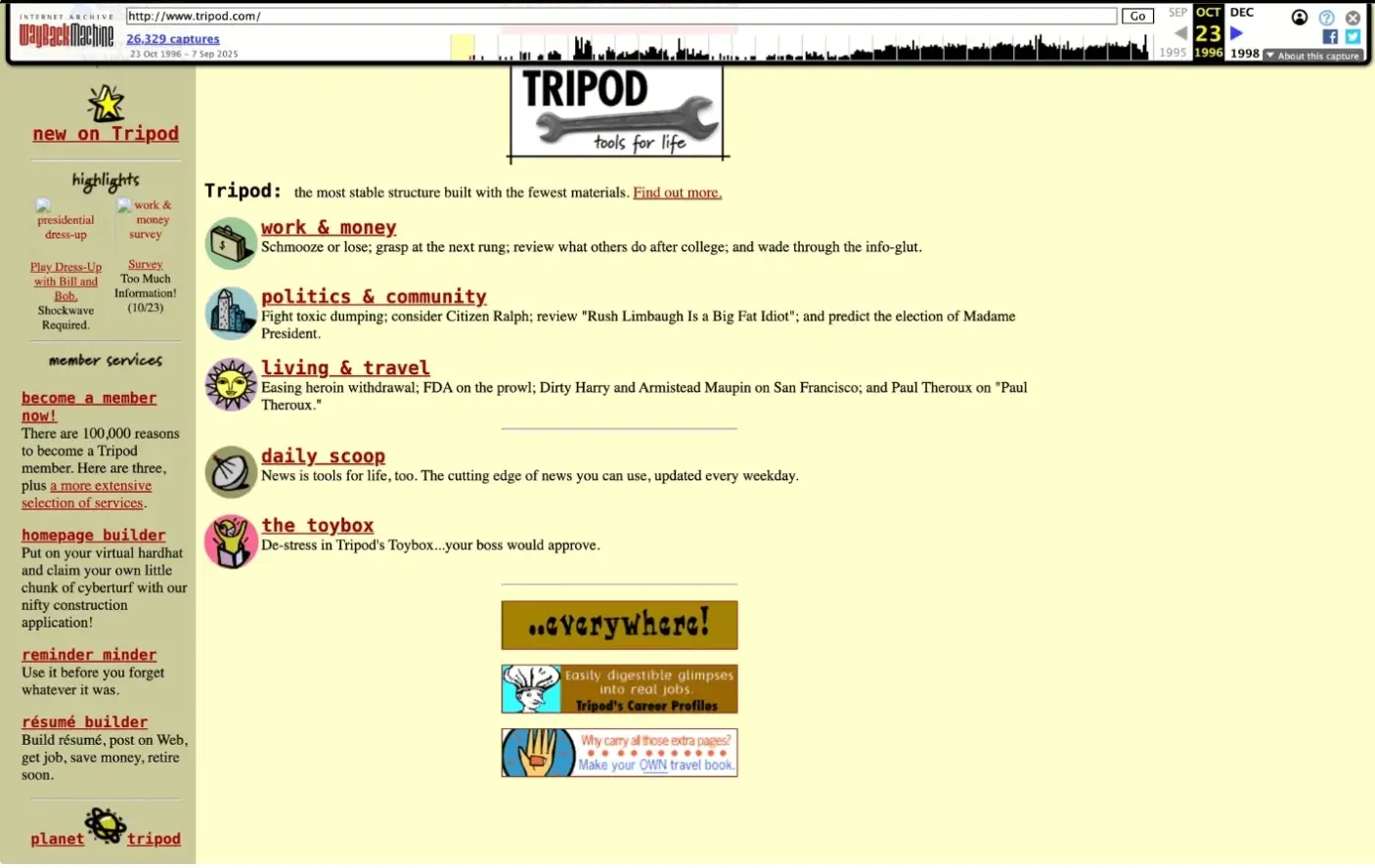
What happened next felt like watching a new continent rise out of the ocean in a single afternoon. Users claimed subdomains on Tripod.com as if they were staking homesteads on digital prairie land, building fan sites, personal diaries, band pages, poetry archives, and gloriously messy experiments that would make modern designers cringe and modern founders jealous.
The flywheel for Tripod starting to work without any paid acquisition strategy, because every homepage contained a link back to Tripod and every new creator pulled friends into the ecosystem, creating an exponential cascade that turned a rural startup into one of the most visited destinations on the web.
Before social feeds and algorithms flattened identity into scrollable streams, Tripod handed users a URL and told them it was theirs to shape, and that simple act of assigning territory created loyalty, creativity, and a sense of permanence that corporate companies couldn’t replicate. In hindsight, it is easy to label Tripod as one of the earliest social networks, but at the time it felt more like an unregulated frontier where the barriers to expression had collapsed and the only constraint was imagination.
The Cost of Scale
Products that have rocket ship growth curves and heroic rises, however, are rarely self-sustaining, and Tripod’s explosion of user-generated content created a new problem that every founder recognizes, which is how to pay for the infrastructure that supports growth without poisoning the very experience that made growth possible.
Advertising became the obvious answer, since it was straightforward to implement, and venture capitalists poured money into internet startups after Netscape’s IPO signaled the birth of the commercial web.
To solve this problem, Peabody tapped one of Tripod’s best and earliest engineers, Ethan Zuckerman. Online advertising was still in its infancy, so there weren’t many reference points or mental models for capturing and monetizing user attention. So, Zuckerman wrote some code that enabled a new way of serving up ads to users, which he called the “pop-up” ad.

His belief was that he could separate ads from user content by placing promotions in a new window, so that users would be able to preserve the sanctity of their personal pages. The solution worked too well, spawning an arms race between advertisers and users that would define the next decade of internet irritation.
Years later Zuckerman would publicly apologize for helping normalize a format that many still consider the web’s original sin.
This tension between open expression and ad-supported economics sits at the center of Tripod’s legacy, because the same infrastructure that empowered millions of users also introduced the monetization model that would shape platforms for decades. Tripod proved that individuals, not corporations, could generate the most compelling content online, but it also demonstrated that freedom at scale required funding, and funding often came with compromises that subtly altered the experience. Founders reading this should feel the familiar discomfort of recognizing that every product decision exists inside a larger economic system, and that even well-intentioned choices can ripple outward in unpredictable ways.
Luck, Timing, and the Wave
As traffic soared and cultural relevance peaked, acquisition offers began arriving with increasing urgency, and in February 1998 Tripod was sold to Lycos for $58 million in stock, a number that felt enormous in Williamstown but would soon look modest against the backdrop of dot-com exuberance.
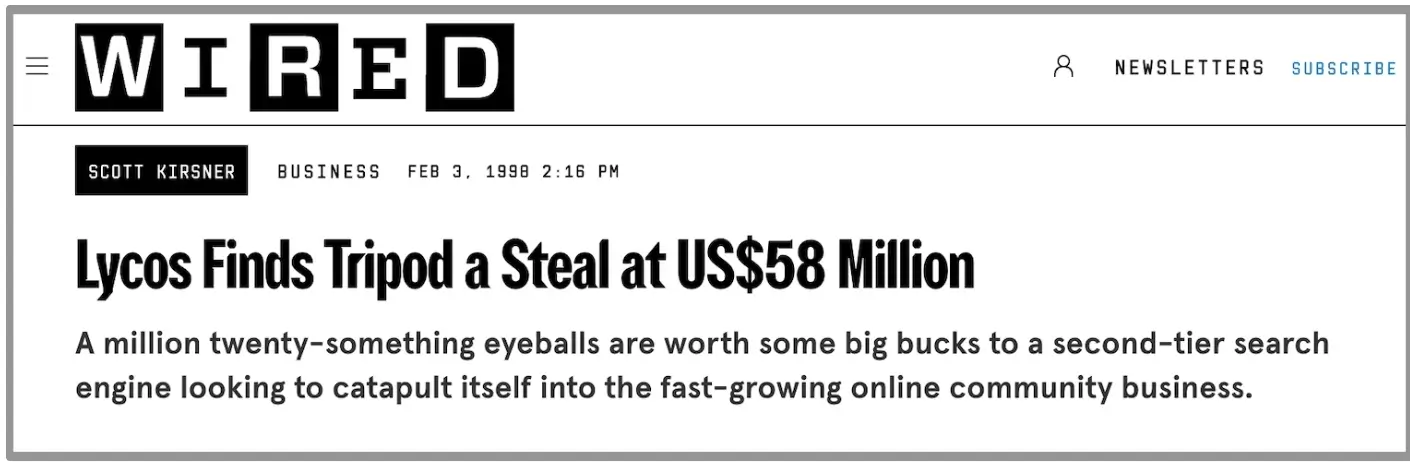
Peabody, still in his twenties, found himself holding stock he was not allowed to sell for two years, during which Lycos’s valuation ballooned amid a market that seemed determined to reward anything associated with the internet. At its peak, the value of his shares had increased roughly tenfold, turning a $58 million paper deal into a figure that brushed against $580 million, even though his personal ownership stake was far smaller and the lockup meant he could only watch the ticker climb and wait.
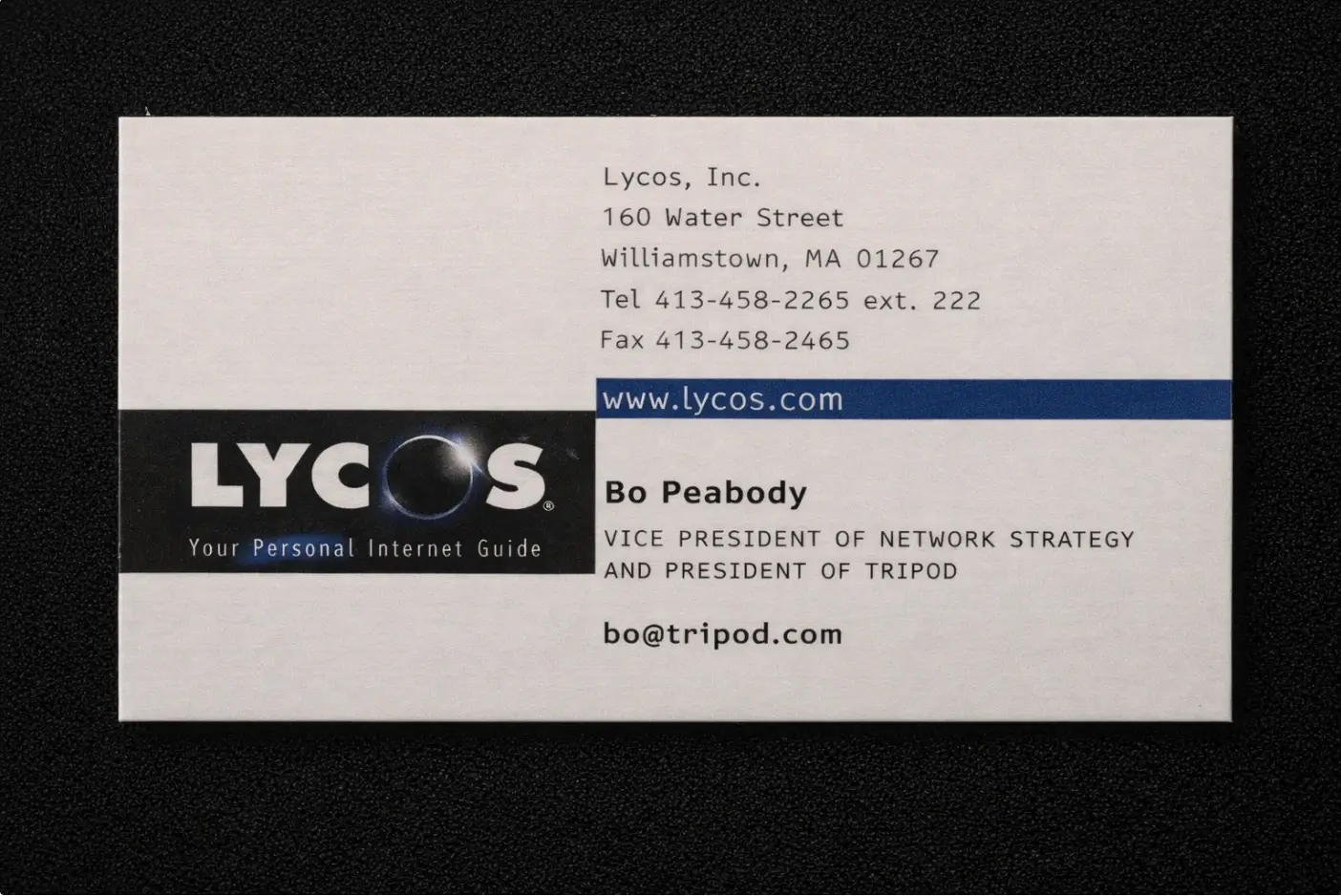
Peabody would later frame his experience with a line that cuts through ego and myth (which he later went on to write a book about): “I was smart enough to realize I was getting lucky.”

Selling almost all of his stock shortly after the lockup expired, just months before the dot-com bubble imploded and erased vast swaths of paper wealth, he moved capital into bonds and real estate while many peers doubled down on internet equities and paid the price. Whether you attribute his timing to foresight, discipline, or a well-calibrated instinct for when hype outpaces fundamentals, the lesson for founders is unmistakable, which is that distinguishing between structural advantage and market mania can determine whether success compounds or evaporates.
Meanwhile, the broader internet landscape evolved quickly. Blogs simplified publishing, social networks centralized identity, and platforms like MySpace and Facebook replaced messy HTML experimentation with profile pages inside corporate ecosystems. By the late 2000s, Tripod’s relevance faded as the web moved toward closed platforms, even though the U.S. version quietly lingered on. Zuckerman would later wonder whether Tripod had simply arrived five years too early, capturing a vision of personal expression before the rest of the internet caught up.
Peabody later wrote that launching the homepage builder was the only time he watched a product change user behavior almost overnight. Even later successes never quite recreated that jolt. Lightning in a bottle rarely strikes twice.
Tripod captured a brief moment when the web was personal and wildly experimental. A small team in a white house in Massachusetts built a tool that let anyone claim a corner of the internet in under a minute, and a key part of their success was building the right product at the right time in the market.
Share this post: