The Foundational Cases That Defined Bad Faith on the Internet
When domain names first appeared, nobody thought of them as “property”. They were just inexpensive conduits to connect with others on the internet and, most importantly, they were easy as heck to register. The idea that a “string of characters” could carry value, identity, or power wasn’t on most people’s radars.
Trademark law already existed, but it was built for storefronts, packaging, and physical goods. It assumed geography, scarcity of shelf space, and clear commercial intent. The internet ignored all of that. It offered a single global namespace, first-come-first-served, with no obvious rules for conflict. And, it was inevitable that there would eventually be some disputes between people (and companies) about what defined (and breached) “property” rights for these digital assets.
Brands discovered their names were gone. Celebrities found strangers holding their identities. Governments realized tourists were typing city names into browsers instead of guidebooks. Courts and arbitration panels were forced to answer questions they had never been designed to handle.
What followed was not a grand statute or a single landmark ruling. Instead, through dozens of disputes under the UDRP and a handful of early court cases, a body of law slowly emerged.
This post traces the cases that did the real work. The ones that defined bad faith, legitimacy, fair use, identity and, ultimately, what it means to own something online.
Bad-Faith & UDRP Doctrine
Before domain names could be bought, sold, litigated, or defended, the internet had a more basic problem: no one agreed on what a domain name actually was.
Was it property or just a contract? Speech or commerce? Use or merely possession? And when someone registered a name and did nothing at all, was that harmless inertia or actionable bad faith?
These early cases didn’t just resolve disputes. They defined the vocabulary courts, arbitrators, and registrars still use today. They drew the first lines around bad faith, legitimate interest, passive holding, and online use, often by analogy and experimentation rather than settled doctrine.
Everything that followed, from UDRP enforcement to modern domain investing, rests on the answers forged here.
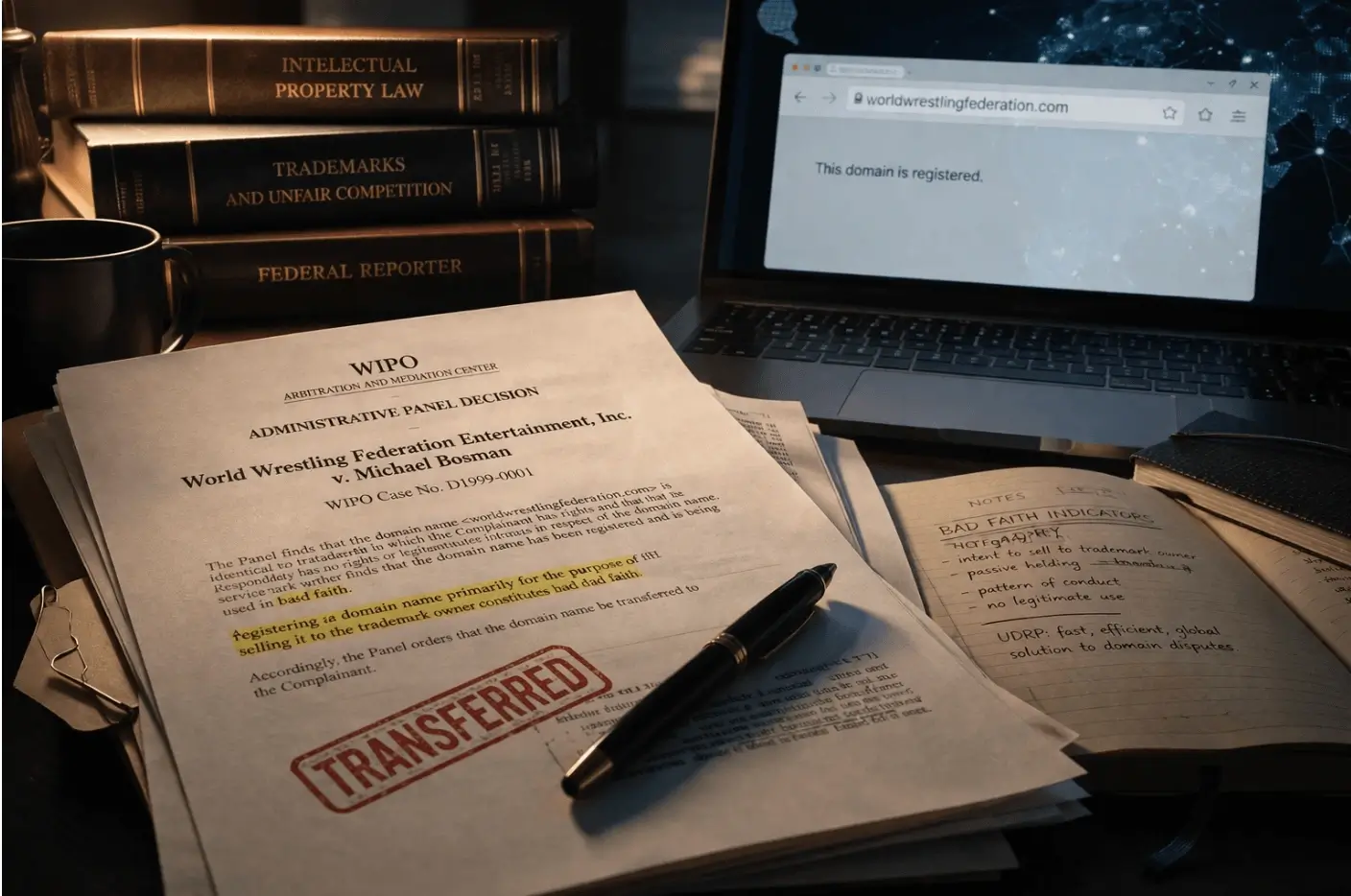
World Wrestling Federation Entertainment, Inc. v. Michael Bosman
The Case
This was the very first case ever decided under the Uniform Domain Name Dispute Resolution Policy, and it would define what cybersquatting meant for decades to come.
Michael Bosman registered worldwrestlingfederation.com, a domain identical to the trademark of the World Wrestling Federation, then one of the most recognizable entertainment brands in the world.
Bosman did not operate a fan site, commentary page, or independent business. Instead, he offered to sell the domain to WWF for a price far exceeding his registration costs.
At the time, domain law was unsettled. Cybersquatting was widely discussed, but there was no established, global mechanism to resolve it quickly. The Uniform Domain Name Dispute Resolution Policy was brand new, untested, and unproven.
WWF filed a complaint anyway, becoming the first company to test whether UDRP had real teeth.
Why Pivotal
The panel ruled decisively in WWF’s favor and, in doing so, set the foundation for the entire UDRP system.
It held that registering a domain primarily for the purpose of selling it to the trademark owner constitutes bad faith. No elaborate deception was required. The intent to extract value from another party’s trademark was enough.
This decision established the clearest possible example of cybersquatting and confirmed that UDRP was not theoretical. It worked. Domains could be transferred quickly, globally, and without traditional litigation.
From that moment on, the rules of the domain economy changed.
Later, on May 6, 2002, the WWF became the WWE after losing a trademark lawsuit to the World Wildlife Fund, forcing the wrestling company to rebrand from World Wrestling Federation to World Wrestling Entertainment. They even launched a "Get the F Out" campaign to mark the change.
Legacy Today
- Established resale-to-the-brand-owner as classic bad faith
- Validated UDRP as a fast, enforceable alternative to courts
- Became the baseline comparison for future cybersquatting cases
- Still cited as the archetypal “easy win” domain dispute
World Wrestling Federation v. Bosman did not introduce nuance. It introduced certainty. It told the internet, for the first time, that domain names were not loopholes. They were law-bound assets, and exploitation had consequences.
Telstra Corporation Ltd. v. Nuclear Marshmallows
The Case
An anonymous registrant acquired telstra.org, a domain identical to the trademark of Australia’s largest telecommunications company. The domain was not actively used. There was no website, no content, and no attempt to sell it back to Telstra.
Under traditional trademark principles, this posed a problem. Trademark law had always focused on misuse. If nothing was happening, what exactly was the violation?
Telstra filed a UDRP complaint anyway, arguing that the registration itself, combined with the registrant’s silence, constituted bad faith.
Why Pivotal
The panel agreed, and in doing so, made one of the most important interpretive moves in UDRP history.
It held that inaction can still be bad faith.
When a mark is sufficiently well-known, and when there is no plausible legitimate reason for holding the domain, passive ownership can satisfy the requirement of bad-faith registration and use. The absence of content did not neutralize intent. It strengthened the inference.
This reasoning became known as the Passive Holding Doctrine, and it fundamentally changed the balance of domain disputes.
Legacy Today
- Eliminated the “I’m not using it” defense for famous marks
- Gave UDRP panels a way to address silent or evasive registrants
- Frequently cited in disputes involving unused premium domains
- Influences modern thinking around intent, even in non-UDRP digital asset disputes
Telstra is the case that taught the internet a subtle lesson. Ownership is not just about possession. It’s about purpose.
Yahoo! Inc. v. Eitan Zviely
The Case
The respondent registered 37 domain names incorporating the YAHOO! trademark and used them to redirect traffic to unrelated commercial sites. The intent was not subtle. The value came from confusion, not content. A number of the names included Yahoo and geographic identifiers, such as: AtlantaYahoo.com, BostonYahoo.com, SeattleYahoo.com, YahooCA.com, YahooDE.com, YahooLA.com, YahooNY.com, and YahooUK.com.
Yahoo filed a UDRP complaint alleging classic cybersquatting. The panel was asked to determine whether this pattern of registration and redirection met the UDRP’s still-new standards for bad faith.
Why Pivotal
This case helped clarify what “use” meant in a digital context.
The panel focused less on formal website content and more on traffic diversion. Using a famous mark to capture users, even briefly, was enough. It did not matter whether the registrant claimed to offer services or merely parked the domain.
Yahoo v. Zviely reinforced the idea that intent could be inferred from conduct, especially when a registrant targeted a well-known brand with no independent justification.
Legacy Today
- Clarified that redirecting traffic constitutes active use
- Strengthened protections for famous marks
- Became an early template for phishing and impersonation cases
- Still cited in disputes involving parked or redirecting domains
Where Telstra dealt with silence, Yahoo dealt with noise. Together, they framed the outer boundaries of bad faith.
Bennett Coleman & Co. Ltd. v. Steven S. Lalwani
The Case
Bennett Coleman & Co., one of India’s largest media companies (parent company to The Times of India), filed a UDRP complaint against a registrant who had acquired a domain corresponding to its well-known publication. The respondent had no connection to the brand and no evidence of legitimate use.
There was no active website. No long history of development. But there were indications that the domain had been registered with the expectation that it could later be sold to the trademark owner.
The panel was asked to determine whether speculative intent alone could satisfy the requirement of bad faith.
Why Pivotal
The panel answered yes.
It held that bad faith can be inferred from the circumstances surrounding registration, even without an explicit offer to sell. Where a registrant targets a known mark, lacks any independent justification, and holds the domain in a manner consistent with resale, intent does not need to be stated outright.
This case helped establish that UDRP panels are allowed to read between the lines.
Legacy Today
- Clarified that intent to sell can be inferred, not just proven directly
- Strengthened the distinction between domain investing and cybersquatting
- Frequently cited when respondents claim speculative innocence
- Complements Telstra’s reasoning on inferred bad faith
Bennett Coleman reinforced a central theme of UDRP jurisprudence: motive matters, even when it is unspoken.
Key Learnings from These Cases
Taken together, these early decisions did something remarkable. They translated abstract trademark principles into rules that could function at internet scale.
They taught panels to look beyond surface-level activity and ask deeper questions about intent, legitimacy, and harm. They established that silence, diversion, and implication could all carry legal weight.
But these rulings were not the final word. Each principle introduced here was tested, refined, and sometimes narrowed by later cases. Edge cases emerged, and new fact patterns forced panels to adapt. What began as broad guidance evolved into a more nuanced and context-dependent system.
Even so, these decisions remain the foundational guardrails of the UDRP process. They defined the initial boundaries, the first workable standards for bad faith, legitimate interest, and use.
Everything that followed, including more complex disputes around identity, geography, fan activity, and free speech, builds on the framework established here.
Share this post: