Maddox.xmission.com: The Internet’s First Angry Influencer

Early bloggers and “influencers” were just a bunch of nerds putting themselves out there, often because they were operating on the edges of internet culture before anyone else had fully caught. And also because most people didn’t even understood how to publish something online in the first place. One of those early voices belonged to a guy named George Ouzounian, who was known online as “Maddox.”
For a stretch of time, Ouzounian was one of the most widely read writers on the internet, despite operating from a domain that looked more like a placeholder than a destination. Maddox.xmission.com was not the kind of URL you would expect to remember, let alone return to, and yet people did, because the writing itself made it difficult to ignore.
The site launched in 1997 and, at the time, Ouzounian was working as a programmer, building websites and software during the day, while the Maddox persona existed alongside that work as something closer to an outlet than an ambition. The site wasn’t conceived as a business or even as a long-term project. It was simply a place where Ouzounian could express his thoughts, which (in practice) meant arguing, often aggressively and humorously, with anyone or anything that caught his attention.
That lack of intention turned out to be part of the appeal. Ouzounian’s writing was a perspective that existed whether you agreed with it or not, and one that made no real effort to accommodate other people’s opinions. He just didn’t give a f*ck.
A Site That Read Like an Argument You Walked Into Mid-Sentence
From the outside, Maddox’s site looked unremarkable, even slightly chaotic, but once you started reading, it became clear that the appeal had nothing to do with design or structure and everything to do with tone.
His posts were written as if the argument had already been decided, as if the reader had simply arrived late and needed to catch up. Titles like “Attention women: until your farts start smelling like cinnamon buns, quit bitching” or “I am better than your kids” weren’t subtle invitations into nuanced discussion, but declarations delivered with such conviction that they pulled you in whether you agreed or not.
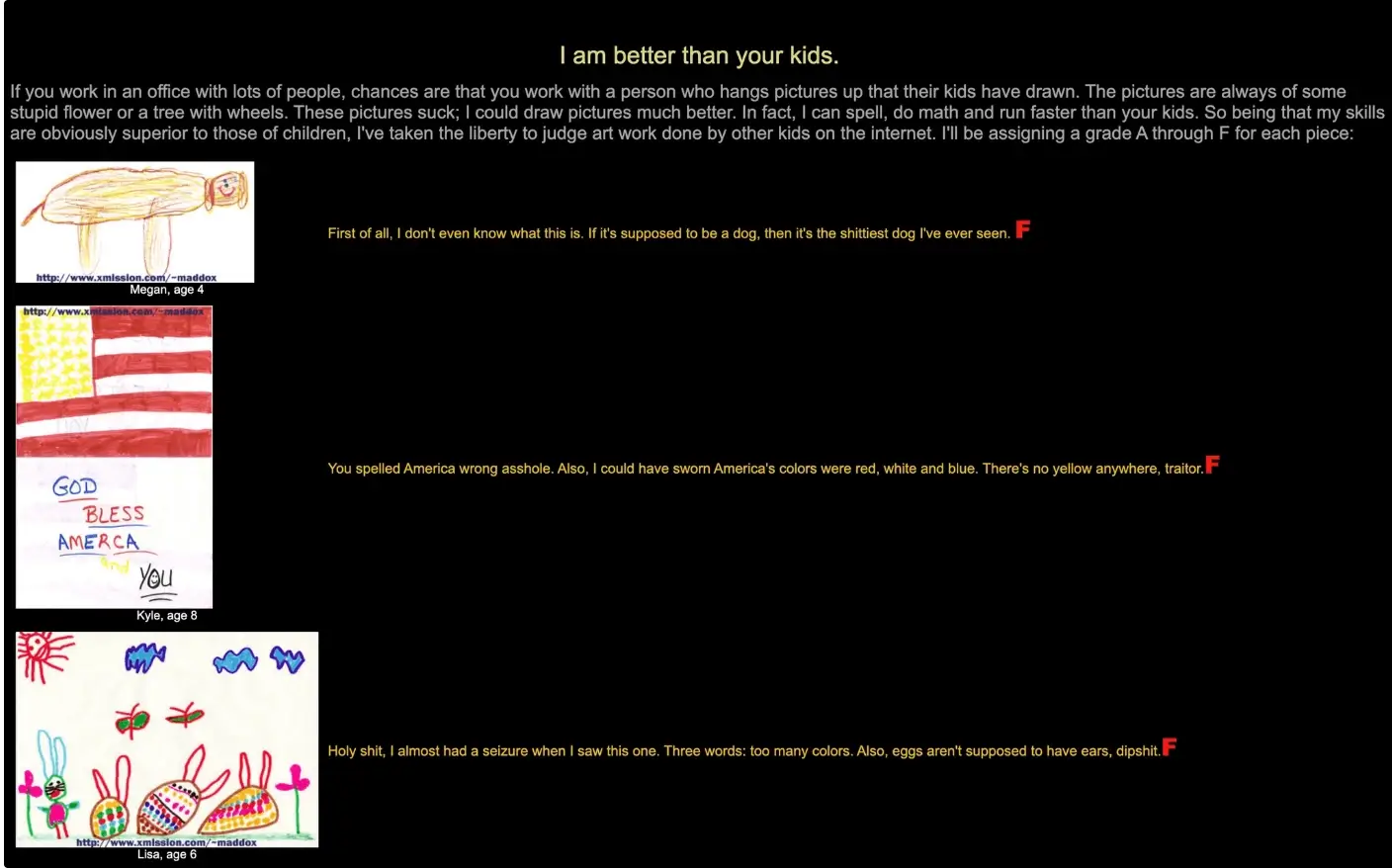
There was a rhythm to it, a kind of escalating intensity that made each paragraph feel like it was trying to outdo the last, and while much of it was clearly exaggerated or satirical, the performance of certainty was the point. You weren’t just reading opinions, you were watching someone lean fully into a persona that felt larger, louder, and more self-assured than the average person behind a keyboard.
In an environment where most people were still tentative, still figuring out how to exist online, that level of confidence stood out, and because it stood out, it spread.
Growth Before Growth Tactics
What’s easy to forget now is that Maddox’s rise happened without any of the tools we now associate with growth. Maddox didn’t benefit from riding some algorithmic wave that carried his content to the masses.
His posts were forwarded through email chains, debated in forums, quoted and re-quoted across corners of the web that didn’t yet feel connected but somehow were. The act of sharing required intention, and if you sent someone a Maddox article, you were effectively saying that it was worth their time, which gave each share a kind of weight that feels unusual by today’s standards.
Over time, that kind of sharing compounded.
By the early 2000s, the site was attracting millions of readers, and Maddox had become one of the few internet personalities whose presence extended beyond the web itself. His work was covered by publications like Wired, which were still figuring out how to talk about internet culture at all.
For a moment, he represented something new, someone who had built an audience entirely online and carried it into the offline world before there was even a clear category for what that meant. He wasn’t just a blogger, because that word didn’t quite capture it yet. He was becoming something closer to what we would now call an internet personality, before that term was widely understood.
From Bits to Books
As the site grew, something subtle started to happen beneath the surface of all that chaos.
What initially felt like a collection of unrelated rants began to reveal a pattern, with the same themes resurfacing again and again, often centered around exaggerated rules about masculinity, intelligence, and what Maddox framed as common sense. The voice was consistent, but now the ideas themselves were beginning to organize, forming a kind of internal logic that made the work feel more cohesive over time.
That logic eventually crystallized into what Maddox called The Alphabet of Manliness, a concept that took the site's tone and perspective and gave it just enough structure to be memorialized in a book.

Not a Pivot, Just a Translation
By the time The Alphabet of Manliness was published, the groundwork had already been laid online, shaped through repetition, reaction, and the gradual refinement that comes from writing in public.
What had been implicit across dozens of articles became explicit, and what had lived natively on the internet was now packaged in a way that could exist outside of it. The voice itself didn’t need to change because it had already been tested, sharpened, and made recognizable through years of exposure.
The same exaggerated certainty, the same confrontational humor, the same willingness to say things most people would instinctively soften, all of it carried over intact, only now it lived in a format that didn’t depend on a link being passed around.
The book didn’t introduce something new so much as reveal what had already been there.
And for a moment, that translation worked almost perfectly, with The Alphabet of Manliness going on to become a New York Times bestseller, a rare outcome for something that had originated entirely from a personal website.
What Happened Next
What followed wasn’t a straight line.
As the internet evolved and platforms began to centralize attention, the distribution that had once worked in Maddox’s favor began to change. The same conditions that had allowed his writing to spread organically were gradually replaced by systems that rewarded different behaviors, different tones, and different forms of consistency.
Maddox continued to write and create (and his site still exists!), but the cultural moment that had amplified his voice no longer operates in quite the same way. The internet had changed, and with it, the conditions that once allowed a voice like his to spread so freely.
Over time, he also became involved in more public disputes, including a widely discussed lawsuit tied to a falling-out with a former collaborator, which brought a different kind of attention, less about the writing itself and more about the friction that can emerge when strong personalities and audiences collide over time.
By that point, though, the shape of the story had already been defined.
The Takeaway
If there’s a through line to Maddox’s story, it isn’t really about the specific platforms he used or the transition from web pages to books, even though those details help frame the context.
What carries through all of it is the strength and clarity of the voice itself.
Maddox grew because what he was putting into the world was immediately recognizable, easy to share, and strong enough to create a reaction, whether that reaction was agreement, irritation, or something in between.
It could move from one person to another without losing its shape, from one part of the internet to another without needing to be re-explained, and eventually into formats that allowed it to exist independently of where it started.
That’s the part that feels most distant now.
Much of today’s writing is shaped in response to feedback before it’s fully formed, adjusted in real time based on what performs well and what doesn’t. Over time, that process tends to smooth things out, making the work more accessible, but often less distinct.
Maddox operated in the opposite direction, writing first and letting the reaction come after, allowing the audience to organize itself around the work rather than shaping the work to fit the audience. And once that existed, everything else, books, recognition, cultural relevance, became an extension of it rather than a replacement for it.
In the end, the thing that mattered most was that Ouzounian found a way to express his voice authentically as Maddox, (whether or not people agreed with his opinions), and that authenticity is something that often gets missed in today’s internet culture with people being afraid to say what they really think in the event of being cancelled.
Although the internet and distribution channels have changed, being authentic in one’s own voice and opinions will never get old.
Long live the angry web.
Share this post: